

5 min read
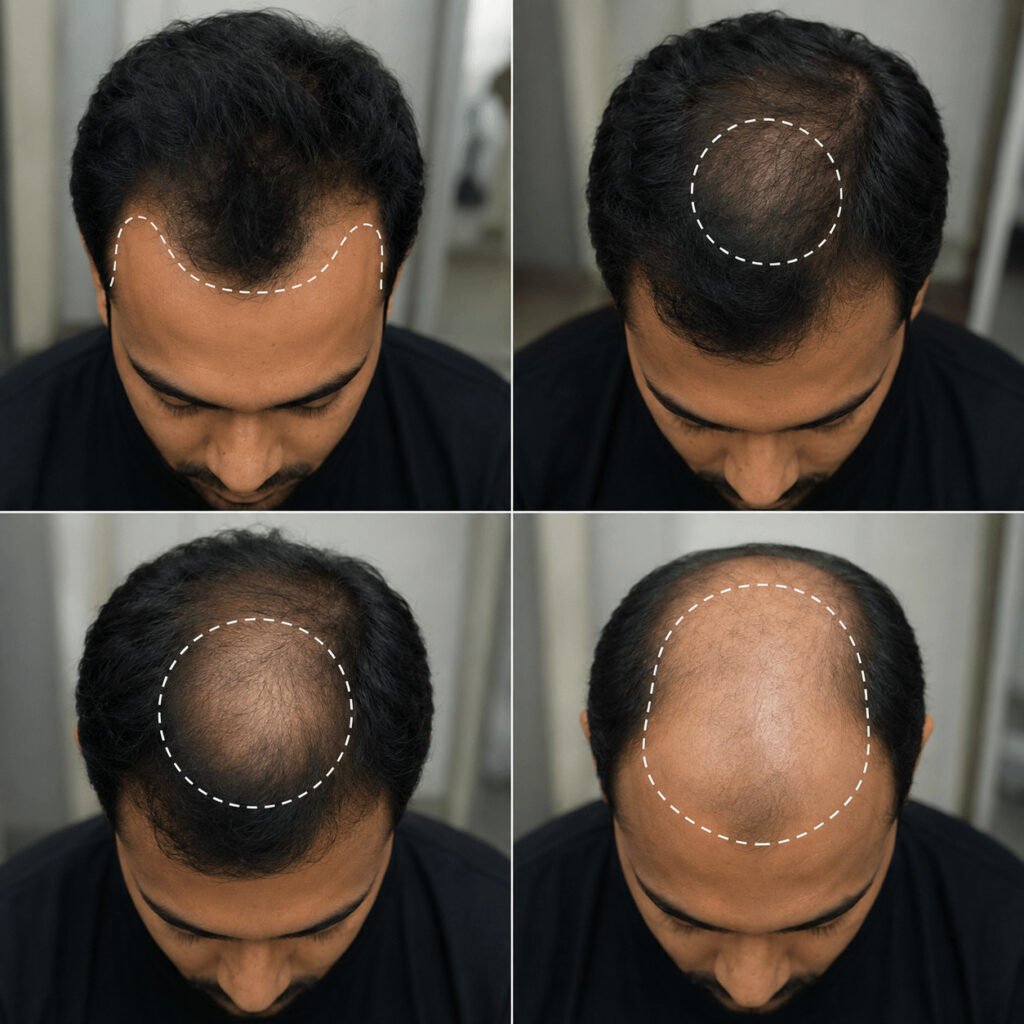
Which Hair Loss Stage Are You? A Bengaluru Man’s Guide to Choosing the Right Hair Patch
Quick answer: Hair loss in men is usually measured on a 7-stage scale, from a barely-receding hairline at Stage 1 to extensive baldness at Stage 7. A hair patch works well at almost every stage — the difference is what kind and how much coverage you need. Early-stage thinning (Stages 1–3) often only needs a small patch at the temples or crown, while advanced stages (5–7) need a full hair system. Knowing your stage before your consultation helps you understand what you’re actually walking in to discuss, rather than guessing.
Most men don’t know exactly how advanced their hair loss is — they just know it’s noticeable. This guide breaks down the stages in plain terms and tells you honestly what solution fits where, so you’re not left wondering if a small patch will be enough or if you need something bigger.
What are the stages of male hair loss?
Male hair loss is typically classified using a 7-stage scale that tracks how a receding hairline and thinning crown progress over time. It starts with a full, unaffected hairline at Stage 1 and ends with extensive, connected baldness across the top of the scalp at Stage 7.
The scale isn’t just for doctors — understanding roughly where you sit helps you have a much more useful conversation at your consultation, because you already know what you’re asking about.
| Stage | What it typically looks like | Coverage usually needed |
| Stage 1–2 | Little to no visible recession, or mild, symmetrical thinning at the temples | None yet, or a small hairline patch if self-conscious about early changes |
| Stage 3 | Clear, triangular recession at the temples forming an M-shape | Small temple or hairline patch |
| Stage 4 | Temple recession plus visible thinning at the crown | Crown patch or a larger combined patch, depending on how connected the two areas are |
| Stage 5–6 | Temple and crown areas begin to merge, leaving a narrowing band of hair between them | Full or near-full hair system covering both areas |
| Stage 7 | Extensive baldness across the top, with hair remaining only at the back and sides | Full hair system |
How do I know which stage I’m at?
The clearest way is a scalp assessment at a consultation, where a specialist can look at density, hairline shape, and how far recession has progressed rather than you guessing from a mirror. That said, a rough self-check comes down to two questions: is the recession only at your temples, or has your crown started thinning too, and if both, is there still a solid strip of hair connecting them?
If you’re mainly noticing your temples, you’re likely in the earlier range. If your crown has joined in and the two areas are starting to look connected, you’re further along than most men realise — this is the point where a full system usually becomes the more practical option over a smaller patch.
Can a small patch work if I’m not fully bald yet?
Yes — this is actually the ideal use case for a small patch. If your hair loss is limited to one area (just the temples, or just the crown), a targeted patch covers exactly that spot and blends into the hair you still have, without the cost or coverage of a full system you don’t yet need.
The mistake some men make is waiting until hair loss has spread before considering any solution at all. Getting a smaller patch early is often simpler, more affordable, and easier to blend than waiting until a full system becomes the only realistic option.
At what point does a full hair system become necessary instead of a patch?
Once temple and crown thinning connect, or hair loss covers most of the top of the scalp, a full hair system generally gives a more consistent, natural result than trying to patch multiple separate areas. Two smaller patches on a widely thinning scalp can end up looking patchy rather than blended.
This is a judgment call best made in person — a specialist can tell you honestly whether your current stage is still patch-appropriate or has moved into full-system territory, rather than trying to sell you on one or the other before seeing your scalp.
Does the base material change depending on my stage?
Not directly — base choice (lace, polyurethane, or silk) is more about how natural you want it to look and how it feels day to day, not which stage you’re at. What does change with stage is size and shape: a small patch is cut to a specific area like the crown or temples, while a full system is shaped to cover the entire top of the scalp.
Whichever stage you’re at, the base still lasts 4 to 12 months before it needs replacing, and you can resume gym and physical activity 24 to 48 hours after a fresh application.
What happens if my hair loss progresses after I get a patch?
If your hair loss continues to progress naturally around a patch, it can usually be adjusted or upsized at your next maintenance visit rather than needing to start over completely. This is one advantage of a patch over more permanent options — it can grow with your situation.
Maintenance visits are monthly, which is also a natural checkpoint for your specialist to reassess whether your current coverage still matches your stage, or whether it’s time to talk about a larger patch or full system.
Key takeaways
- Hair loss is typically staged 1 to 7, from minimal recession to extensive baldness.
- Early-stage thinning (temples or crown alone) usually only needs a small, targeted patch.
- Once temple and crown thinning connect, a full hair system usually gives a more natural, consistent result.
- Base material choice is about look and feel, not stage — but sizing and shape change based on how much coverage you need.
- Monthly maintenance visits are also a natural point to reassess if your stage has changed.
- The most accurate way to know your exact stage is an in-person scalp assessment.
Not sure which stage you’re at, or what it means for you? [Book a free consultation at Topee’s Bellandur or Old Airport Road studio ?]
Reviewed by Topee’s lead hair specialist. Topee is a men’s hair solutions studio in Bengaluru (Bellandur and Old Airport Road), specialising in non-surgical hair systems and patches.
Still weighing it up?
The consultation is free, takes 30–60 minutes, and you leave with an exact price and no obligation.
Book a free consultation